Kit Carson County · Northern Colorado
Drain Cleaning in Burlington, CO
Burlington is the seat of Kit Carson County and the last real town on I-70 before Kansas, with about 3,170 people at roughly 4,170 feet. Its post office opened in April 1887, the first townsite a mile to the west was abandoned when the Rock Island railroad put its depot here, and the town incorporated in January 1888, the year trains started running.
Clogged drain in Burlington?
Answered 24/7
Including holidays and storms
Licensed local plumbers
Licensed in Colorado
Winter-ready
Frozen lines and thaw calls
Price ranges up front
Know the range before they come
Burlington homes and their sewer lines
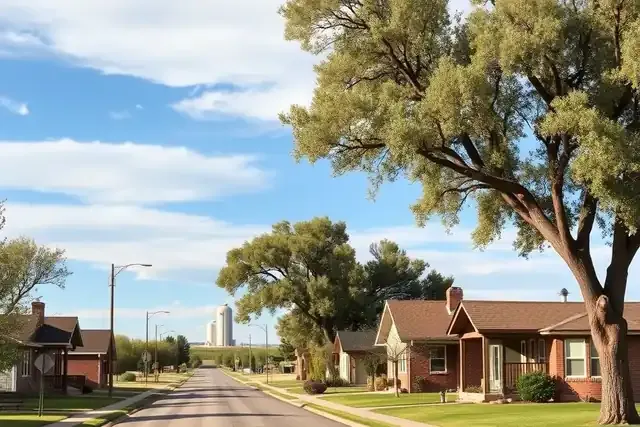
Burlington's older blocks around the courthouse and the Rock Island tracks hold frame and brick houses from the 1910s through the 1950s, with ranch homes and some manufactured housing filling the edges of town toward the I-70 interchanges.
The City of Burlington runs water and sewer. Its sewage has been treated in an aerated lagoon system built in 1974 and updated in 2014, which the city is replacing with a new plant using sequencing batch reactors and ultraviolet disinfection; water and sewer rates rose in January 2026 to help pay for it.
Houses built before about 1970 in Burlington usually have cast iron drains inside and clay tile laterals; most homes from the 1980s on were plumbed in PVC.
Burlington drain problems
Most Burlington drain calls come back to old clay laterals, the shade trees planted beside them and hard plains winters. Elm and cottonwood roots find the joints, cast iron scales up under kitchens, and wind-driven cold reaches drains in crawlspaces and back porches.
Typical Burlington drain cleaning prices
| Job | Typical range |
|---|---|
| Sink, tub or toilet clog in a Burlington home | $125–$300 |
| Main line cleared to the city sewer | $200–$550 |
| Cutting elm or cottonwood roots from a clay lateral | $250–$650 |
| Hydro jetting a scaled or greasy main | $350–$900 |
| Sewer camera inspection and locate | $150–$400 |
| Thawing a frozen crawlspace drain | $200–$600 |
A town that moved a mile to meet the railroad
Burlington's founders platted their first townsite in 1887 about a mile west of where the town stands now, betting on where the tracks would run. The Chicago, Rock Island and Pacific chose a different spot for its depot, the original site had title problems, and buildings were hauled east to the new location. Trains began running in 1888, the same year the town incorporated, and Burlington became the county seat of Kit Carson County.
That origin still shapes the place. The old business district and the oldest houses sit close to the tracks and the courthouse, and the town spread outward from there in later decades. Interstate 70 then added a commercial strip of motels, fuel stops and restaurants along Rose Avenue and the interchanges, the last ones in Colorado before the Kansas line about 12 miles east.
Lagoons from 1974 and a new plant on the way
Since 1974, Burlington's sewage has gone to an aerated lagoon system, updated in 2014. The city now says those lagoons no longer meet its state and federal discharge permit standards, and it has hired engineers to build a replacement: a sequencing batch reactor plant for secondary treatment, ultraviolet disinfection, and an aerated lagoon for holding solids. Water and wastewater rates rose at the start of 2026 to help pay for it.
None of that changes what a homeowner owns. The plant and the public mains are the city's; the lateral from the house to the main is yours, from the drains inside to the tap at the main. If several neighbors on one block back up at the same time, call the city's public works line as well as a plumber, because a blocked public main is the city's to clear.
What sits under an older Burlington yard
A house built in Burlington before the 1970s almost always drained through cast iron under the floor and vitrified clay tile out to the street or alley. Clay was laid in short lengths, and each joint was packed with mortar or a simple gasket that has aged for 60 to 100 years. In plains soil that bakes dry in July and soaks up spring storms, those joints shift. A camera run often shows small offsets where paper snags, root hairs coming through a joint, or a belly where the pipe sags and holds water. Some problems can be maintained with a cleaning every year or two; a cracked or broken section usually needs a spot repair or a liner.
Roots from trees that were planted on purpose
Nothing taller than grass grew here naturally, so every big elm, cottonwood and ash in town was planted and watered by somebody, many of them decades ago to shade houses and break the wind. Those trees are large now, and in a dry climate their roots look for any steady moisture. A leaking clay joint is exactly that. Root intrusion is the reason a Burlington main line often slows gradually for weeks, then stops all at once when a wad of paper hangs on the roots. A cutter on a drain machine reopens the line; a camera afterward tells you whether you have one bad joint or a whole line of them.
Wind chill and frozen drains
Burlington's record low is 25 below zero, and cold here almost always arrives with wind. Drains freeze where cold air can reach them: crawlspaces with open vents, mudroom additions on piers, utility rooms with no heat, and manufactured homes with loose or missing skirting. The usual sign is a single fixture, often a washer standpipe or a kitchen sink on an outside wall, that won't drain on a cold morning while the rest of the house is fine. Close crawlspace vents for winter, tighten skirting and keep heat in rooms with plumbing. Don't use a torch on plastic pipe; warm the area and call for a thaw if it does not clear.
Farmhouses and septic outside the city
Outside city limits, from the German-Russian farming area northwest of town to ranches south toward Cheyenne Wells, homes rely on private wells and septic tanks. A tank that has not been pumped in years sends solids into the leach field, and once a field clogs it is expensive to fix. Watch for slow drains all through the house, gurgling, a sewage smell outdoors, or grass that grows lush over the field. Pumping every three to five years for a typical family keeps the system working, and a plumber can clear the pipe between the house and the tank when it plugs.
First steps when a Burlington drain backs up
- 01
Stop the water
Shut off the washer and dishwasher and hold off on showers; in a Burlington basement, water from upstairs fixtures ends up at the floor drain.
- 02
Look at the thermometer
On a subzero morning with wind, a single stopped drain on an outside wall is probably ice, not a clog.
- 03
Check with neighbors
If several houses on your block back up at once, call the City of Burlington as well.
- 04
Find the cleanout
It is usually in the yard between the house and the alley or street, or in the basement near where the main leaves the house.
Signs your Burlington main line needs attention
- A Burlington basement floor drain that gurgles or seeps when the washer empties
- Toilets that bubble when a tub drains
- Root fibers on the cable after a past cleaning
- The same slow line coming back every few months
- A sewage smell near the cleanout cap on a warm day
Call if you notice
- Elm roots working into a clay lateral behind an older Burlington house
- A main line that backs up into the basement floor drain after laundry day
- A crawlspace drain near the north wall freezing in a January cold snap
- Mud and wheat chaff from farm clothes settling in a utility sink line
- A septic line slowing at a farmhouse outside the city limits
Burlington drain questions
Who maintains the sewer in Burlington?+
The City of Burlington owns the public mains and the treatment plant. The lateral from your house to the city main, cleanout included, is the property owner's to maintain.
Why is Burlington building a new sewer plant?+
The city says its 1974 aerated lagoons, updated in 2014, no longer meet discharge permit standards, so it is replacing them with a mechanical plant. That work is on the city's side; your lateral stays the same.
How cold does Burlington get?+
The weather record reaches 25 below zero, in both January and December. Drains along outside walls and in crawlspaces are the ones that freeze.